

Automation and AI in technical work: cutting repetitive tasks without losing control
How to separate deterministic rules, AI interpretation and professional judgement inside one process, where automation creates real gains, and which limits keep autonomy from becoming operational risk.
Por Lead de Dados · Dados & Automação
In short
- Automation handles what has a known rule; AI comes in where the input varies or requires interpretation; relevant decisions stay with the professional.
- The largest gain usually sits in small, frequent tasks, not only in large processes.
- AI used as a first triage layer changes productivity without transferring responsibility.
- The greater the autonomy of the system, the more explicit the limits of what it can query, change and send.
- Not every task needs AI: where a deterministic rule solves it, that rule is cheaper, more predictable and auditable.
A large share of a qualified professional's time is still consumed by activities that require little technical capacity. Copying information between systems, organizing documents, updating controls, checking fields, consolidating spreadsheets, preparing recurring reports, searching for data across dozens of files, standardizing formats, sending notifications and following up on pending items.
None of those activities stops being necessary. The problem is using hours of specialized work to do them manually every time. The useful question is not how to replace that professional with AI, but which parts of their work truly require knowledge, judgement and technical responsibility. Whatever sits outside that core becomes a candidate for automation.
Are automation and artificial intelligence the same thing?
No. Automation works well when there is a known rule: if A happens, do B. Artificial intelligence becomes useful when the input varies or the task requires interpretation, such as classifying a request written in dozens of different ways or extracting information from unstructured documents. In a real process, the two usually work together.
| Type of activity | Best approach |
|---|---|
| Known, repetitive rule | Deterministic automation |
| Interpretation of variable information | Artificial intelligence |
| Relevant technical decision | Responsible professional |
The professional stops operating the process and starts supervising it
- Receive the information and open the document
- Identify the subject and copy the data
- Register it in the system and compare with history
- Check inconsistencies and update controls
- Communicate and create a follow-up task
- Automatic capture of the input
- Extraction and classification of the content
- Validation by deterministic rules
- Update of the systems involved
- The specialist reviews only the exceptions
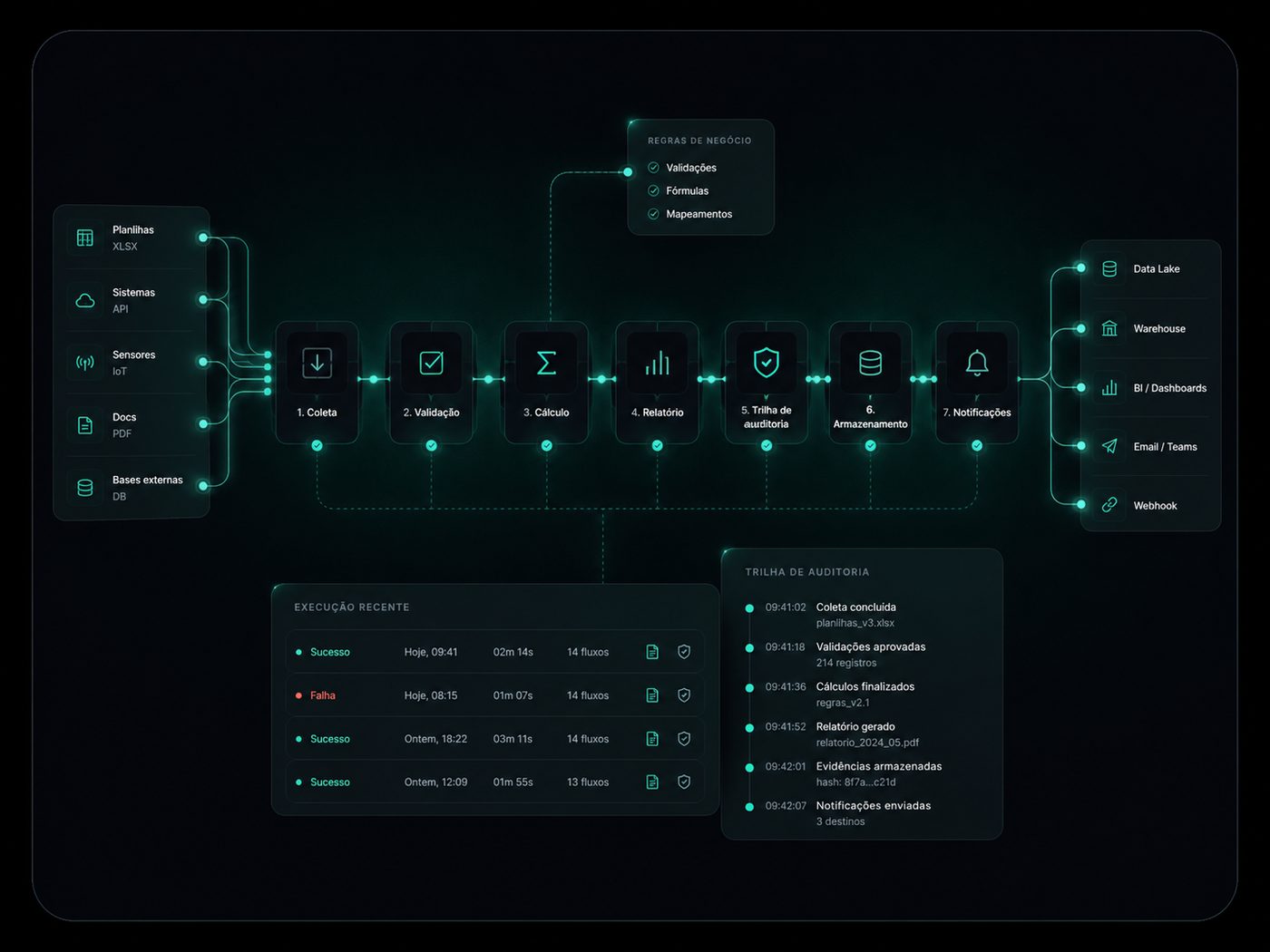
The first gain is in invisible administrative tasks
Many companies look for automation only in large processes, while the real volume sits in small activities repeated every day. Opening an email and saving an attachment takes a few minutes. Updating a spreadsheet row too. The weight appears when that repeats hundreds or thousands of times.
- High execution frequency
- Relatively predictable procedure
- Low intellectual value per run
- Large accumulated time consumption
Those four characteristics identify a good candidate. The return is not in the time saved on a single run, but in the sum.
AI automates what did not fit a simple rule
Traditional automation depends on structure. A system easily reads a tax number, an amount and a date in defined fields. The difficulty appears when the information sits inside a message, report, contract or PDF with no standard. Language models turn part of that unstructured content into information the process can use: subject, entities, relevant dates, described obligations, amounts involved, points needing review and the suggested next step.
That output does not need to be the final product. Often it is just the input to the next automation. This is where AI stops being a conversation tool and starts working as a component of an operational architecture.
AI as a first triage layer
One of the most efficient uses in technical routines is triage. Facing a large batch of documents, the professional does not need to start by reading them all. The system organizes the material by situation and the specialist starts with what requires analysis.
Automated prioritization is not automated decision: responsibility for the conclusion stays with the professional.
The specialist starts with the nine atypical cases. The effect on productivity is immediate, and no decision on the merits was transferred to the system.
The best automation works while nobody is watching
A professional responsible for following hundreds of operations has to log into systems periodically, without automation, to check whether anything changed. With the right architecture the logic inverts: the system watches and calls the person when something relevant appears. It is the difference between looking for problems and being told when a potential problem shows up.
- Data is updated
- The system checks for changes
- No relevant condition: the process continues
- Relevant condition identified
- Alert with context
- Professional analysis
Agents execute sequences and need limits
Newer systems let models use tools, query information and run sequences of actions: receive a request, look for data in authorized sources, classify the demand, prepare a reply, record the case and route it. The greater the autonomy, the greater the control has to be.
NIST frames the use of artificial intelligence within continuous risk management, with assessment, monitoring and governance across the system life cycle, and maintains a specific profile for generative AI. ISO/IEC 42001 sets requirements for AI management systems, focused on governance, risk, transparency and accountability.
- What the system may query
- What it may change
- What it may send on behalf of the organization
- Which decisions require human approval
- Which activities generate a mandatory record
- In which situation the process must stop and ask for intervention
Not every task needs artificial intelligence
Since AI became the centre of the conversation, there is a tendency to use it on problems a simple condition would solve better. If the rule is to send an alert when a due date is five days away, there is no point asking a language model whether the alert should be sent. A deterministic rule is cheaper, faster, predictable and auditable.
AI comes in when it adds capacity: reading a request and suggesting the most appropriate service category, comparing two reports and pointing out relevant changes, structuring data that arrived without a standard. A professional architecture avoids putting a model where a logical instruction would work more safely.
The greatest potential is in integration between systems
Many companies already have an ERP, CRM, GIS, financial platforms, document systems, spreadsheets, databases and apps. The problem is rarely a missing system. It is missing connection. Information arrives through one channel, has to be copied into another and transformed again to feed a third tool. Manual activities are born in that gap, and that is the gap the automation layer occupies.
Professional knowledge has to enter the system
There is a difference between installing AI and building operational intelligence. A specialist with ten years of experience recognizes combinations of signals that require attention. While that knowledge lives only in their head, the organization depends on them to identify every case. Part of it can become structure, such as a rule that classifies a case as priority review when certain conditions occur together and a document is missing.
Another part goes into models, checklists, searchable knowledge bases and assisted processes. The professional starts teaching the system to operate under a technical logic, which is far more advanced than subscribing to a tool.
The system has to know when it does not know
A system should not be forced to answer everything. It needs to be able to record insufficient information, conflict between sources, low confidence, an out-of-pattern situation and the need for human review. In technical operations, a wrong answer delivered confidently is usually more dangerous than no answer. Recent OECD studies on algorithmic management in workplaces point exactly to explainability and accountability as critical issues in this adoption.
The goal is not automating 100% of the process
That metric leads to bad decisions. There are parts of the work worth keeping human. The goal is finding the best combination of speed, cost, quality, control, traceability and accountability. In some processes, 80% of the activities can be automated. In others, perhaps 30%, and even so removing 30% of repetitive tasks from a specialized team's routine is a relevant gain. The right question is how much technical time we can give back to the professional.
How to identify a real automation opportunity
- Inputwhat the operation receives and through which channel
- Handlingwhat someone has to do manually
- Decisionwhere technical interpretation exists
- Transferwhich information gets copied between tools
- Controlhow the team finds out something went wrong
- Outputwhich result has to be produced
A poor implementation produces the opposite effect. If the AI generates content that has to be redone, creates irrelevant alerts or requires full checking of everything it produces, it merely adds another layer of work. That is why every automation should be assessed by operational result: how much time was reduced, how many steps left the path, how many errors were avoided, how much rework disappeared and how many exceptions started being caught earlier.
From individual AI use to an orchestrated operation
- AI as a toolthe professional starts everything manually
- AI as an assistantsupport on specific tasks
- AI integrated into the processthe system runs steps automatically
- Orchestrated operationautomation, systems, AI and people in the same flow
Before choosing a model, platform or tool, you have to understand the process: where waste exists, where repetition exists, where risk exists, where the technical knowledge sits, which decision has to stay human, which systems already exist, which data is available and which information is sensitive. The technology choice comes afterwards. The opposite path, buying AI and then looking for a problem for it to solve, is increasingly common and rarely works.
The best application of artificial intelligence in professional work may not be the one where the user notices more AI, but the one where they notice fewer useless tasks: less time hunting for information, less repeated data entry, less mechanical checking, fewer transfers between systems and more time to analyse and decide.
Technical references
Desenvolvimento de pipelines, APIs e automações para integração de dados ambientais em escala.
This topic is part of one of HIGGN's areas of work. See the related solution
Related content
Need to structure this process in your operation?
Share the technical context of your operation and we will come back with an initial analysis.
Request a diagnostic